...Chris Orr’s anxious complaint ‘AI cannibalises our art’ seems to complete—and enhance—his immense labyrinthine image of automaton-like faces absorbed into motherboard components. Those words about AI not only serve to focus the viewer’s attention. They articulate feelings I have much heard of late (Orr’s disturbing slogan ought to be printed on signs and carried about by young creators at the next Art Fair).
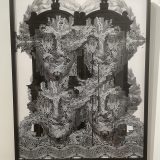
Nimbly knitting persona with digital concerns and technology is Chris Orr‘s 'Quadrilogue'... Satisfying in its layered and broken symmetry, it incorporates an engraving of a classical sculpture, a head of Venus, sliced through by a darker-toned plane of Renaissance architectural entablature...
Orr’s work 'Served bold’ (2023) is an exceptionally sophisticated and captivating digital print, which was, for the three judges, utterly arresting. It is a work that cleverly combines imagery from historical engravings with the intricate circuitry of a computer motherboard and it speaks to the prominence of technology in the 21st century and the power it exerts over every aspect of contemporary life.
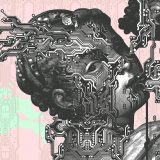
'Served bold' draws a connection between the role of historical printmaking in democratising imagery, the dissemination of information, and the global and totalising power of the computer.
When graphic designer-turned-artist Chris Orr got a call from Caroline Field, curator of the Australian Catholic University’s art collection, the atheist’s first thought was, “Uh-oh, I’m in trouble. Sacrilege?”
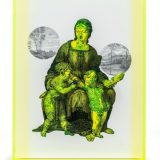
In fact she was looking to acquire his striking work Motherboard Portal Verde. It reworks Rafael’s Madonna of the Goldfinch with a circuit board tracing her face. “Maybe it was really intuitive,” he says, pointing to its likeness to the now-ubiquitous PPE masks. “I’d like to claim that, but it’s not.”